
People always
say that being a second generation Vietnamese American is a pretty special
thing, and I suppose they’re right.
Partly, it means that I can speak two languages, be a part of two
very different cultures, and be the only one in my city with the name,
“Chi.” It also means I
get the best of both worlds – I get my running water, my flushing
toilets, my computer, and my
own room with all of my several hundred favorite books.
I have a relatively better appreciation for all these things than
most people, and I have been blessed with the knowledge that I am actually
lucky to have all of these worldly goods.
Typically,
when we are born into an environment with all the luxuries of modern
civilization, it is easy to take our lives for granted.
It is easy to assume that everyone lives as dependently on material
things as we do, on electricity and Microsoft, on kitchen cleaners and
Chevrolet, on air conditioning and digital cameras.
And even when we do get a glimpse of the “other half,” it’s
only through that trusty widescreen television of ours, from some
documentary on PBS or the Learning Channel.
Then the hour-long documentary ends, we shut off the magic talking
box, and on we go with our lives because that other world is so far away
it could be pretty fiction for all we know.
The only way
we can know for sure that it exists is to go there ourselves and see it
with our own eyes. And
somehow, when we’re there, whether it’s rural Vietnam or wartorn
Israel or impoverished Poland, the realization is inescapable.
We are lucky, and they
are unlucky and we have so much capacity to give to them.
Our lives are burdened with two or three times as many material
things as we need, and they don’t even have the security of three daily
meals.
It’s quite
simple for me to say all these things when I’m focused on these matters,
but throughout my daily activities and my every day existence, the
strength of my resolutions and my understanding of the extent of my good
fortune fades all too easily. When
I’m standing there on Vietnamese soil and an eight-year-old boy from the
street children shelter comes up to me and asks me to take him back to the
US with him, and says that when he gets older and finishes his education
and starts working, he’ll pay me back, I’m given a chance to renew my
appreciation for what I have. When
I’m sitting in a room full of college students who are recipients of a
VNHELP scholarship and I’m hearing stories of the things they overcame
to go to college, I can’t hold back my confused rush of anger at the
unfairness of the world, awe for their amazing capacity to bear hardship,
and determination that I should find a way to help them further as well as
make my life worth everything that has been so easily granted to me.
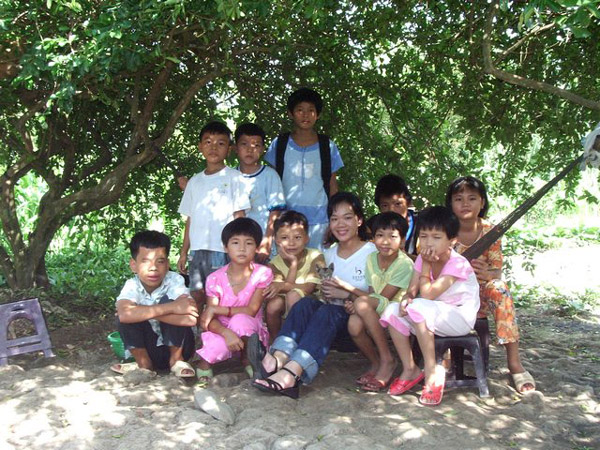
Going back to Vietnam this time was an incredible experience for me. Sixteen is a wonderful age to be at, still young enough to play with the street children in the shelter who range from ages eight through seventeen, old enough to talk to the scholarship recipients who are already attending university, and most definitely old enough to be able to absorb all of my surroundings, ask the appropriate questions, and listen to the people I meet with a more mature and open perspective. I was able, also, to ask questions of the teachers at the street children shelter and determine for myself what it was that these children needed, how they could be helped further, and what I could do to expand the program further and raise more money to allow more children to be looked after by the shelter.
Phuong Chi
[ View pictures of Phuong Chi's trip ]